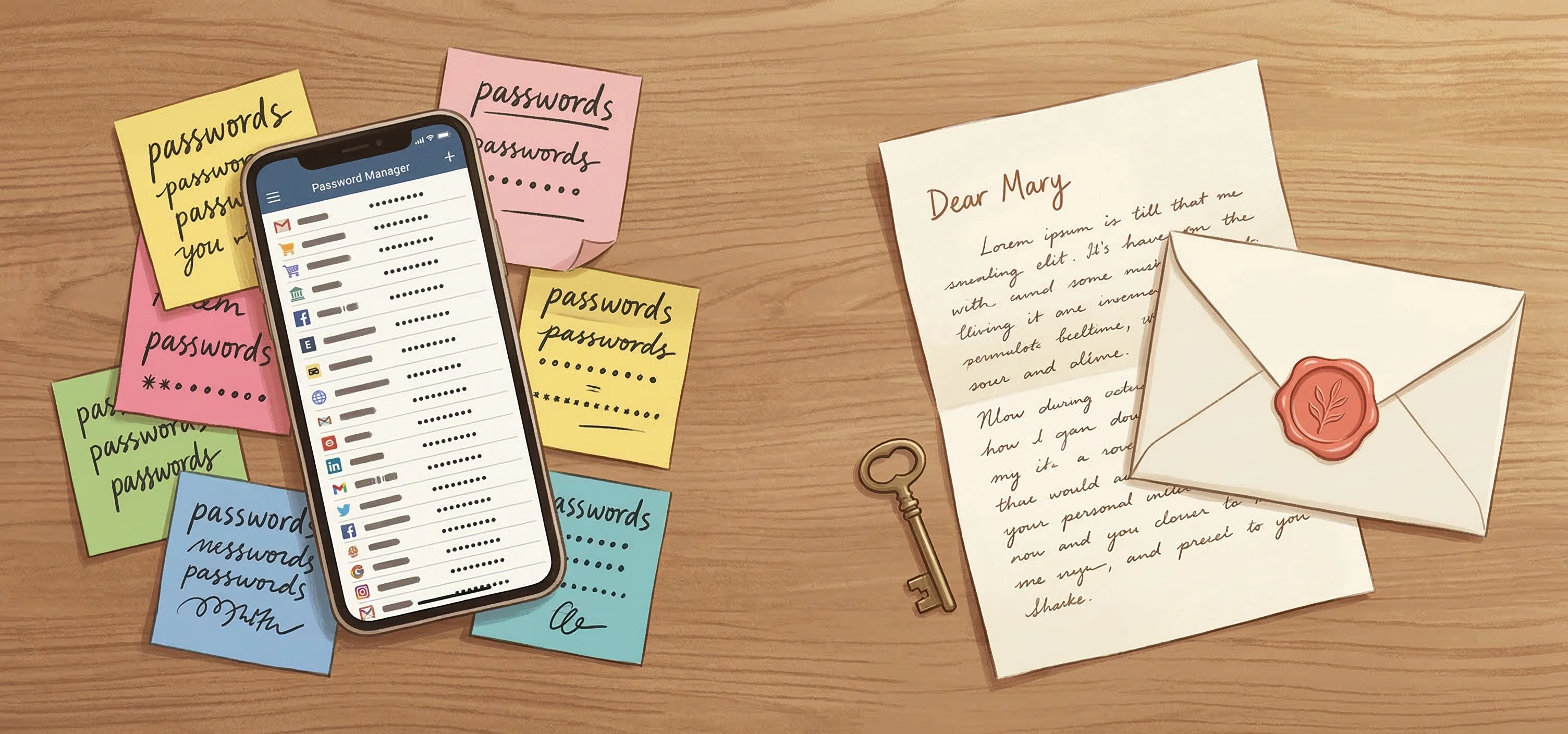
My password vault has over 3000 entries. Brokerage accounts with large portions of my savings sit next to a ski forum I signed up for in 2011. My crypto exchange login shares space with a WordPress site I built for a friend's summer-event and never deleted.
I'm fully digital. Large digital footprint. Accounts everywhere. Most of them are completely irrelevant to the people who'd need to sort through my life if I weren't around to do it myself.
So what happens when my family gets access to all 3000 entries at once?
Good news, I can access Frank's digital life! Bad news: there are 3000 entries here and I have no idea which ones matter. Should I worry about Last.fm as much as business banking? What's this 'Binance' thing? Why does he have 47 different AWS accounts?
Does that sound like inheritance planning? Or is that digital hoarding with a bow on top? A real digital estate plan gives people context, not just a pile of credentials. If you need the direct checklist, start with how to pass on passwords after death.
Emergency Access Isn't What You Think
Most password managers — 1Password, Bitwarden, LastPass, Dashlane — now offer some kind of emergency access. Designate a trusted contact, set a waiting period, and they can request your vault if something happens. Sounds reasonable.
But the details matter.
It's all or nothing. Your contact gets every password you've ever saved. There's no way to say "give my spouse the bank accounts but keep my business infrastructure credentials for my business partner." Everyone gets everything, or no one gets anything.
Someone has to know it exists. If your family doesn't know you set up emergency access, or doesn't know who the designated contact is, the feature sits there doing nothing.
Time delays aren't verification. Most systems wait 24-72 hours and then grant access. They can't tell whether you're dead, in a coma, or just hiking without signal for a long weekend. And if someone maliciously requests access while you're unreachable for a few days: who cancels the timer?
It only triggers when someone asks. There's no dead man's switch. No system checking whether you're still around. Your family has to actively initiate the process, which means they need to know exactly what to do during what's probably the worst week of their lives.
Compare that to a proper dead man's switch: it checks on you through methods you choose, escalates when you don't respond, and only releases anything after confirming you're genuinely unavailable.
Passwords Are the Smallest Part of the Problem
Password managers store credentials. But inheritance isn't just about logging into accounts.
What about the video I recorded explaining things to my kids? The letter with instructions for my business partner about what to shut down and who to call? Insurance policies with claim procedures? Crypto seed phrases with step-by-step recovery instructions written for someone who doesn't know what a derivation path is?
None of that fits in a password manager. And honestly, it shouldn't. That's not what they're built for.
Password managers need to be fast. Browser extensions that autofill in milliseconds. Mobile sync. One-click access to any account, anytime. They're daily-use tools, optimized for convenience and speed.
Inheritance is the opposite. Deliberate. Multiple verification steps before anything gets released. Different people getting different information based on what they actually need.
You wouldn't use a safe deposit box to store your house keys. Different job, different tool.
They Work Together
This isn't about replacing your password manager. Keep using 1Password or Bitwarden, they're great at what they do.
But put your master password in Trustbourne. If you want the mechanics before doing that, the step-by-step flow is here.
Along with context about which of those 3000 accounts actually matter. Instructions for what to do with each one: close it, transfer it, preserve it. Documents your family will need. Messages you want specific people to have.
Your business partner gets the infrastructure credentials and partnership docs. Your spouse gets personal accounts and financial instructions. Your kids get the letter you wrote them and a crypto wallet to get them started. Nobody has to worry about the ski forum password.
Your password manager handles the daily noise. Trustbourne handles what actually matters when you can't hand it over yourself.
The Gap
Password managers protect your digital life while you're living it. They're built for speed, convenience, daily use.
But inheritance isn't about convenience. It's about getting the right information to the right people at the right time, and about making sure they understand what to do with it.
Emergency access bolts inheritance onto a tool designed for something else. Better than nothing, but not built for the job.
Your family needs both. Without both, there's a gap. And gaps in inheritance planning tend to become permanent.
Frank has been using password managers since 2007. He builds Trustbourne — encrypted inheritance vaults with a dead man's switch. See current plans or start at trustbourne.com.