Disclosure: Trustbourne publishes this page and sells one of the services compared below. We have tried to make the comparison useful even when another option is a better fit. Product details were checked against official public pages on 18 September 2026. We did not create paid accounts or run end-to-end release tests. If something has changed, contact us and we will correct it.
There is no universally best dead man’s switch.
The right choice depends on what you want to hand over, what should trigger that handover, how technical the recipient is, and what should happen if the provider itself disappears.
That matters because products described as a “dead man’s switch” often solve different problems. Some detect that you have stopped responding. Some wait for a trusted person to request access. Some transfer data from one platform. Others help recover a crypto wallet or send a final message.
Comparing them as though they were interchangeable produces tidy rankings and poor decisions.
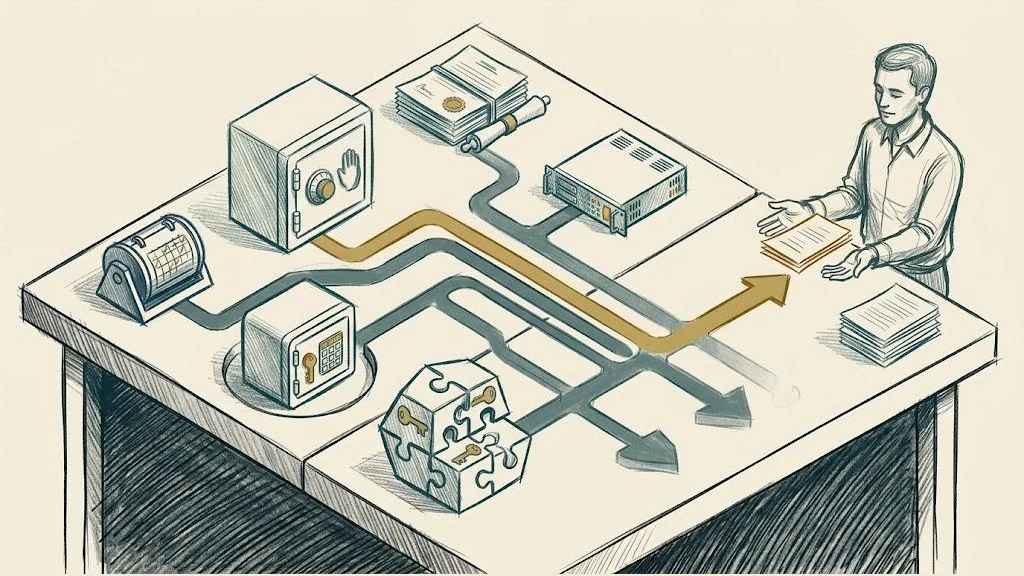
Short answer
- Choose a general encrypted handover service if you want selected files and instructions delivered after a sustained period of non-response.
- Choose password-manager emergency access if the main goal is access to an existing password vault and you trust the recipient with that breadth of access.
- Use platform legacy tools for data held by that platform. Google’s tool is useful for Google data; it is not a plan for everything else.
- Use a notary-backed vault when you are eligible, want documents integrated with the local inheritance process, and confirmed death is the right trigger.
- Choose a crypto-first inheritance product if wallet control, seed recovery, multisig or MPC is the central problem.
- Self-host only if someone other than you can maintain, test and recover the system.
- Use a safety check-in app if you want an alert when you miss a check-in, rather than encrypted file delivery.
Compare the mechanism before the brand
| Type | Typical trigger | Best for | Main trade-off |
|---|---|---|---|
| Scheduled handover service | Repeated missed check-ins followed by escalation | Files, instructions and practical continuity across several services | Requires ongoing check-ins and confidence in the provider’s release process |
| Request-based encrypted vault | A recipient asks for access and the owner does not reject it | Granular sharing without routine check-ins | Nothing happens unless the recipient remembers to ask |
| Password-manager emergency access | A trusted contact requests vault access | Broad credential access | The recipient may receive far more access than a handover task requires |
| Platform legacy tool | Inactivity signals inside one provider | Data from that provider | Coverage stops at the platform boundary |
| Notary-backed vault | Confirmed death and estate process | Documents integrated with local succession | Eligibility limits and no incapacity trigger |
| Guided estate-planning hybrid | Interview, liveness or product-specific clearance | Creating a plan with assisted prompts | Components may use different mechanisms and fees |
| Crypto-first inheritance | Claim, time lock, guardian approval, multisig or key-share reconstruction | Wallets, seed material and on-chain assets | More technical recipient flow and narrower data scope |
| DIY or self-hosted switch | A timer, cron job or custom heartbeat | Maximum control and custom behaviour | You own hosting, monitoring, email delivery, backups, patching and succession |
The questions that actually decide
1. What starts the process?
A scheduled check-in service acts after sustained non-response. A request-based service waits for someone to make a claim. A platform tool watches activity inside its own ecosystem. A crypto product may depend on a beneficiary claim, a time lock or several key holders.
None is automatically better. But the distinction is fundamental.
A request-based tool avoids reminder fatigue, but it can fail quietly if the recipient does not know that the service exists. An inactivity-based switch can act without a recipient initiating anything, but needs enough warnings and delay to avoid premature release.
Check what happens after one missed response. A serious service should provide several opportunities to stop the process before sensitive information is disclosed.
2. Who can decrypt the information?
“Encrypted” does not answer this question.
Ask whether the provider holds a release key, whether only you hold it, whether the recipient needs a separate passphrase, and whether recovery still works if the provider is unavailable.
A provider-assisted release is easier for a non-technical recipient. A true zero-knowledge design reduces provider access, but shifts responsibility to you and your recipient. A passphrase stored only in your head is excellent privacy and dreadful inheritance planning.
3. What must the recipient do?
Look beyond “we notify your beneficiary.”
Does the recipient need an account or app? Must they keep a recovery key? Are identity or legal documents required? Can they open the files in an ordinary browser? How long does access remain available? Can they practise the process before an emergency?
A technically elegant system can still fail because the person receiving it cannot complete the final steps.
4. What happens if the service disappears?
Every provider can close, be acquired or change direction.
Look for export options, ordinary file formats, local recovery tools, a documented shutdown process and enough notice to migrate. “EU-based,” “decentralised” and “built to last” are not substitutes for an exit procedure.
The same question applies to self-hosting. If the server, domain, certificates, backups and email delivery all depend on you, the system may share your single point of failure.
5. Does access match legal authority?
A switch can provide information. It does not automatically decide who owns an asset or who is legally allowed to act.
A will, executor, probate process, power of attorney and an online account provider can each impose different requirements. Treat technical access and legal authority as separate parts of one plan.
6. What maintenance does it require?
Contacts change numbers. Instructions go stale. Payment cards expire. Wallets move. Domains lapse. Apps stop receiving updates.
Check what the owner must maintain, what the recipient must preserve and whether the complete process can be tested. A plan that worked when created is not necessarily a plan that works five years later.
7. How are the ongoing costs funded?
A one-time fee is not automatically suspicious. It may fund a product whose continuing costs are small, shift operating costs to the user or a blockchain, charge separately for later actions, or be supported by other recurring products.
The question changes when a provider promises years or decades of hosted storage, monitoring, messages, security updates, support or human verification. Those costs continue after the original payment has been spent. Ask whether they are funded by a reserved portion of the fee, recurring add-ons, transaction charges, a broader subscription business or continued new sales.
If the model depends mainly on an ever-growing supply of new customers to service older lifetime accounts, durability becomes a real concern. Call it a funding mismatch or continuity risk, not a pyramid scheme: no investment return or recruitment reward is being promised.
General handover services
For recurring services, every price below is shown per year. Where a provider advertises only a monthly price, we show the twelve-month equivalent and say that it is annualised. One-time setup fees remain labelled as one-time because pretending they are annual subscriptions would be equally misleading in the opposite direction.
Trustbourne
Mechanism: scheduled check-ins followed by reminders, contact verification, a final warning and release. Trustbourne publishes a 40-plus-day escalation process for its standard 30-day check-in cycle. Contacts do not need an account or app.
Encryption: files are encrypted in the browser. In Seamless mode, Trustbourne holds a separate per-vault release key and could technically decrypt the files; the trade-off is simpler recipient access. Maximum Privacy removes that provider-held release key, but recipients need a passphrase shared through another route.
Best for: European users who want selected files and instructions released proactively to non-technical recipients.
Not the best fit when: you only need password-vault access, want a crypto-native wallet mechanism, refuse routine check-ins, or require a system you operate yourself.
Price checked 18 September 2026: Core is displayed at €79/year for founding members (€99 regular); Plus at €149/year (€199 regular). Plus includes custom 7–90-day check-ins and Maximum Privacy.
Official pages: How it works, security, pricing.
AbsentKey
Mechanism: request-based access rather than periodic check-ins. A recipient requests a shared secret; the owner can approve or deny the request. If the owner does not respond during the configured 1-to-365-day window, access is granted.
Best for: someone who wants a very cheap, local-first encrypted vault with granular secret sharing and no recurring check-in routine.
Why it is not a direct substitute for Trustbourne: AbsentKey solves a narrower problem. It does not independently notice that you have stopped responding. The recipient must know the service exists, install the app, retain access to it and actively request the right secret. Only then does the response timer begin. Its public material does not describe the same multi-stage contact-verification and final-warning process that Trustbourne publishes, nor did we find a comparable shutdown-notice and migration commitment. That can be a reasonable trade for the price, but it moves more of the failure risk to the recipient and the owner’s original setup.
Price checked 18 September 2026: free local vault; Premium displayed at $19.99/year.
DGLegacy
Mechanism: an asset and password inventory combined with a “Heartbeat Protocol” using signals such as app activity, connected services and email check-ups. Paid plans advertise additional human phone verification before inheritance notifications.
Best for: families wanting a maintained asset inventory, assigned beneficiaries and trustee-style support around the claiming process.
Main limitation: DGLegacy can notify people and organise information, but it does not itself transfer ownership. Its public pages provide less detail about the exact inactivity threshold and full escalation timeline than we would want for comparing false-release and delayed-release risk.
Price checked 18 September 2026: Gold is $119.88/year equivalent and Platinum $155.88/year equivalent when annualising the displayed monthly prices. DGLegacy also offers annual billing, which may be lower.
Guided estate-planning and hybrid services
HEIR / HeirLegacy
HEIR is worth including because it competes for the same customer attention, but its public offering is not one simple general-purpose dead man’s switch.
Current consumer entry point: the $88 one-time Legacy Interview is a guided voice-or-text session that produces a downloadable, updateable starting plan. HEIR says the resulting legal packet remains unexecuted until the user completes the relevant local formalities.
Switch model: HEIR’s public material spans several mechanisms: Pulse notifications, on-chain proof-of-life and crypto transfer, and a separate death-clearance flow. Its beneficiary journey is consequently more crypto-shaped than Trustbourne’s browser-based file handover. When checked, the older my.heir.es consumer deployment was paused while the main HEIR site and crypto tooling remained active.
Best for: someone who wants guided estate discovery or a crypto/on-chain inheritance mechanism and accepts a broader, more complex product set.
Why it is not a direct substitute for Trustbourne: the $88 interview mainly helps produce a plan; it is not by itself the same as maintaining an encrypted document vault with one published check-in, escalation and recipient-release process. HEIR’s public pages describe different critical paths for notifications, soft legacy and on-chain assets.
Funding question: HEIR says its death-critical “floor” can remain available regardless of subscription status while also selling annual consumer and professional services. Its public material does not explain how free recurring death-critical operations would be funded indefinitely. That is an unanswered continuity question, not proof that the model cannot work.
Price checked 17 September 2026: Legacy Interview $88 one-time; HeirOS is displayed at $88/year after its trial. The one-time interview and recurring service are different products.
Notary-backed vaults
IZIMI
IZIMI deserves a place in this comparison because, for a Belgian reader, it is the strongest free alternative. It is provided by the Belgian notarial profession rather than a conventional software company.
Mechanism: IZIMI stores up to 1 GB of documents, includes access to Belgian notarial deeds from 2015 onward, and transfers or destroys vault contents after confirmed death through the notarial estate process. Users can choose full or partial transfer to legal heirs, include selected contacts, or choose destruction. Under the published rules, documents selected for contacts must also go to the heirs.
Best for: a Belgian citizen who wants free, institutionally backed document storage integrated with notarial acts and the ordinary inheritance process.
Why it is not a direct substitute for Trustbourne: IZIMI acts after confirmed death. It does not use missed check-ins to cover coma, incapacity, disappearance or prolonged unreachability. Distribution follows the notarial and legal-heir framework rather than a flexible operational handover to different family members, advisers or business contacts. Heirs or contacts must complete the estate process and download transferred material within the published 24-month window.
Price checked 18 September 2026: free for its basic services, including 1 GB storage. Its continuity is backed by the Belgian notarial profession rather than lifetime fees from individual users.
For the detailed Belgian comparison, read Notary vaults vs Trustbourne: which one protects your digital legacy?.
Password-manager emergency access
Bitwarden’s Emergency Access lets a designated trusted contact request access to a password vault. The owner can approve or reject the request; otherwise access is granted after the configured waiting period.
This is a good fit when the password manager already contains the necessary information and the recipient should receive broad vault access. It is less suitable when different people should receive different files, when instructions matter more than credentials, or when you want the system to detect non-response without waiting for a request.
Other password managers may offer different emergency or family-access models. Check the exact account requirements, waiting period and scope before assuming they work the same way.
Platform-specific legacy tools
Google’s Inactive Account Manager can notify trusted contacts or share selected Google account data after Google detects a configured period of inactivity. Google uses several activity signals and can share different data with different contacts.
It is useful, free and worth configuring if important information lives in Google. It does not cover data held by Apple, Microsoft, a password manager, a bank, a hosting provider or a crypto wallet.
Platform tools should be part of a broader plan, not mistaken for the broader plan.
Crypto-first inheritance
Crypto inheritance is a separate category because “access” may mean reconstructing a key, collecting enough multisig signatures, recovering an MPC wallet or receiving stored seed material.
| Service | How it works | Best fit | Main trade-off |
|---|---|---|---|
| Casa | Multisig vault with a recipient claim and six-month owner challenge period. Memberships with inheritance start at $250/year. | Supported-asset holders wanting guided multisig inheritance | It is a wallet architecture and the ordinary flow relies partly on Casa’s recovery role. |
| Vault12 Guard | Splits encrypted seeds, keys and files across trusted Guardians. Enough Guardians must approve recovery. Inheritance is $359.88/year equivalent, annualised from $29.99/month. | Protecting recovery material across several crypto assets | Recovery depends on Guardian availability and a recipient who can complete the restore. |
| Bron Wallet | Seedless MPC wallet with a beneficiary claim, 180-day delay and cancellation by the owner, beneficiaries or Guardians. Essentials is displayed at $200/year when billed annually. | Users prepared to adopt Bron’s wallet architecture | Newer ecosystem and dependent on its MPC service structure. It does not cover the rest of someone’s digital life. |
| Inheriti | Splits encrypted information into shares. A Merge Authority starts recovery; configured dead-man-switch methods can release the validator share after owner non-response. Setup is a €39.99 one-time fee plus add-ons, not an annual subscription. | Configurable secret sharing without moving assets into one wallet | More roles, shares and components for recipients to assemble. |
For wallet maps, exchanges, seed phrases and recovery instructions, see our crypto inheritance guide.
DIY and self-hosted switches
A self-hosted switch gives you control over the code, data and trigger. It may be appropriate when the person maintaining it is not also the system’s only operator.
The maintenance list is the catch:
- hosting and monitoring;
- domain and certificate renewal;
- email delivery;
- software updates and security patches;
- encrypted backups and recovery tests;
- documentation another person can understand;
- someone who will take over administration when you cannot.
An open-source project can remove vendor lock-in. It cannot remove operational responsibility.
If you choose this route, test it from the recipient’s side. Trigger a non-sensitive sample message. Confirm it arrives. Restore the backup. Give the documentation to the person who would inherit the system and leave the room.
The deeper problem is that a system meant to work when you are unavailable can still depend on infrastructure only you know how to maintain. We cover that separately in Why self-hosting your dead man’s switch defeats the point.
What “EU-friendly” should mean
An EU flag in the footer is not enough. European users should check where the provider is established, which law governs the contract, where files and backups are stored, which subprocessors receive metadata, how cross-border transfers are handled, and whether pricing and consumer terms make sense locally.
Trustbourne is operated by a Belgian company under Belgian law and EU consumer rules. Files and encrypted backups stay in EU data centres, with no US cloud provider in the storage path. Prices are in euros, and the product distinguishes practical handover from the legal authority that still belongs in a will, mandate or estate process.
That does not make every European service automatically safer. It does reduce avoidable jurisdiction and data-residency uncertainty for a European family, and it means Trustbourne’s product, terms and shutdown commitment were written for this context rather than adapted from a US-only estate model.
Where Trustbourne fits
Trustbourne is designed for one particular job: delivering selected files and practical instructions to people you trust after a sustained period in which you cannot respond.
It combines:
- scheduled check-ins;
- several warning stages before release;
- email, SMS and WhatsApp channels;
- verified contacts who do not need accounts;
- encrypted file storage;
- a choice between easier provider-assisted release and Maximum Privacy;
- a published provider-shutdown commitment.
That does not make it the answer to every problem.
Use Google’s tool for Google data. Use password-manager emergency access when complete password-vault access is the actual requirement. Use a crypto-first system when wallet control is the central problem. Use a lawyer or notary for legal authority. Self-host when someone else can genuinely inherit the infrastructure.
Use Trustbourne when the job is practical, cross-service handover: the files, context and order of operations that otherwise exist only in your head.
A simple decision path
Do you only need data from one platform? Start with that platform’s legacy tool.
Do you need someone to take over your entire password vault? Use password-manager emergency access and test the recipient flow.
Is the main problem control of crypto assets? Compare wallet-native, multisig and secret-sharing inheritance systems.
Do you need selected files and instructions delivered without waiting for a recipient to initiate a claim? Compare scheduled handover services.
Do you need only a safety alert or final personal message? Choose a product designed for that outcome rather than a sensitive-data vault.
Do you want to operate everything yourself? Name the second administrator before calling the design complete.
Frequently asked questions
Is a dead man’s switch the same as a digital will?
No. A switch can deliver information or provide access. A will records legally relevant wishes and appointments. In many cases you need both. See Dead Man’s Switch vs Digital Will.
Can a dead man’s switch release accidentally?
Any automated process can fail. Look for repeated warnings, several contact channels, a meaningful grace period, a clear way to stop escalation and a release flow that can be tested without exposing real secrets.
Is zero-knowledge encryption always better?
It provides stronger protection against provider access, but inheritance adds another requirement: someone else must eventually decrypt the information. If the only passphrase disappears with the owner, the encryption worked and the handover failed.
What happens if the provider closes?
That depends on the service. Check for data export, local decryption, ordinary file formats, notice periods and migration instructions. Do not accept “built to last” as the whole answer.
Is self-hosting safer?
It can reduce provider dependence and give you full control. It also makes you responsible for maintenance, monitoring, delivery and recovery. Self-hosting changes the failure modes; it does not abolish them.
How often should the plan be reviewed?
Review it when accounts, wallets, contacts, legal arrangements or recovery methods change. At minimum, run a recipient-side test regularly enough that changed phone numbers, expired links and forgotten instructions do not remain hidden for years.
Methodology
We included representative active services from the main mechanism types a consumer is likely to encounter. We used official product, pricing, help, security and documentation pages. We did not rank providers with one numerical score because the products solve materially different jobs.
“Best for” and “trade-off” are editorial assessments. Prices and product claims are attributed to the providers and were checked on 18 September 2026. “Not publicly documented” is preferable to filling a gap with an assumption.
This page should be rechecked at least quarterly. Product mechanics, pricing and active status change.
Official sources checked (23)
Product details were checked against official provider and documentation pages.
- Trustbourne: how it works
- Trustbourne: security
- Trustbourne: pricing
- AbsentKey
- AbsentKey: request-based access
- DGLegacy: how it works
- DGLegacy: pricing
- HEIR
- HEIR: product
- HEIR: pricing
- HEIR: Pulse
- IZIMI
- IZIMI: cost
- IZIMI: post-death options
- Bitwarden Emergency Access
- Google Inactive Account Manager
- Casa inheritance
- Vault12 pricing
- Bron digital inheritance
- Inheriti pricing
- Inheriti dead-man-switch methods
- Dead Man’s Switch help
- Open-source self-hosted dead-man’s-switch project